
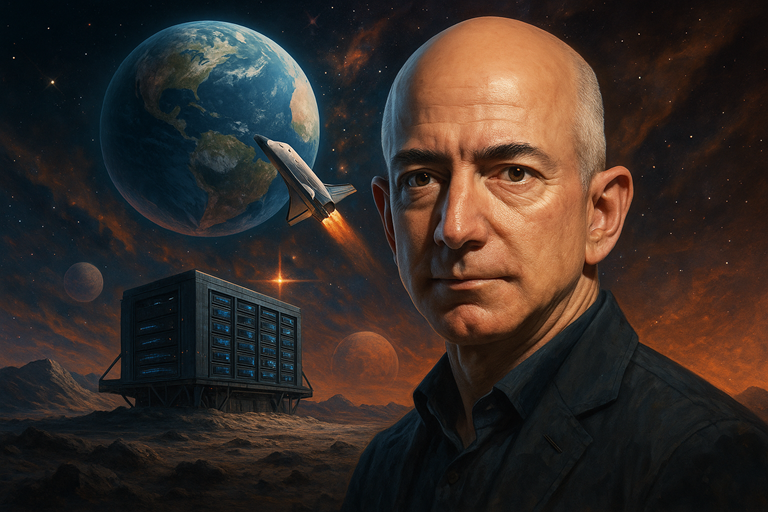
🌌 Space Data Centers: Jeff Bezos' Bold Vision
🔍 Introduction
Artificial Intelligence (AI) has become one of the main pillars of technological transformations over the past decade and plays a vital role across various industries.
In this context, Jeff Bezos, with his bold vision, aims to explore relocating data centers to space to minimize energy consumption and environmental impact.
🌍 Challenges of Ground-Based Data Centers
High Energy Consumption
Ground-based data centers consume a huge amount of electricity, which is often supplied by fossil fuels, leading to increased carbon emissions.
Water Consumption for Cooling
Traditional cooling systems require large amounts of water, putting pressure on local water resources and ecosystems.
Carbon Emissions and Environmental Impact
Energy production and data center operations contribute to greenhouse gas emissions, which in turn accelerate global warming.
🚀 Space Data Centers: The Future Solution
Continuous Solar Energy
In space, solar panels are always exposed to sunlight and can provide continuous clean energy for data centers.
Natural Cooling
Space is naturally cold, so data centers can be cooled without water or complex systems, achieving higher efficiency.
Reduced Carbon Emissions
Using solar energy and natural cooling allows space data centers to have a much lower carbon footprint than ground-based ones.
⚖️ Ground vs Space Data Centers
📊 SWOT Analysis of Space Data Centers
Strengths
- Continuous renewable energy
- Lower environmental impact
- Reduced operational costs in cooling
- Innovative technological edge
Weaknesses
- High initial investment
- Technical challenges in space deployment
- Dependence on launch schedules and rockets
Opportunities
- Global demand for AI and cloud services
- Government and space agency collaborations
- Leadership in sustainable tech
Threats
- Space debris risk
- Potential regulatory hurdles
- Competition from terrestrial renewable-powered data centers
🌍 Social & Economic Impacts of Space Data Centers
Economic Growth & Job Creation
Developing space-based data infrastructure can create new industries, employment opportunities, and stimulate global tech economies.
Environmental Benefits
Reducing energy consumption from fossil fuels lowers greenhouse gas emissions and helps mitigate climate change impacts.
Technological Innovation
Encourages the development of cutting-edge AI, robotics, and satellite technologies that can spin off into other sectors.
Global Connectivity
Space data centers could improve connectivity and cloud service accessibility for remote or underserved regions worldwide.
🔮 Future Vision: AI & Space Synergy
Jeff Bezos' vision for space data centers aligns perfectly with the rising demand for sustainable AI infrastructure. By placing data centers in orbit, powered by perpetual solar energy and cooled naturally by space, we can minimize environmental impact while supporting the next generation of AI applications.
This strategy could transform how humanity approaches energy-intensive technologies, providing a blueprint for integrating space exploration with global sustainability goals.