
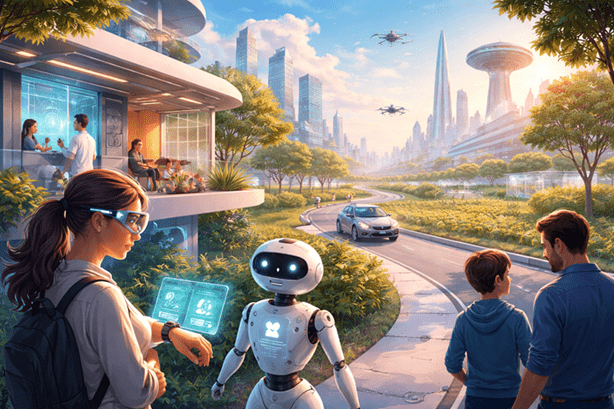
🤖 What Will Your Life Look Like in 2035?
Artificial Intelligence and the Future of Everyday Life | A 10-Year Vision
Roadmap to the Future: From Today to 2035
Artificial Intelligence will transform from a "tool" to an "environment." But what does this mean?
AI Penetration Across Life Domains (2024-2035)
💡 Key Insight: By 2035, AI will no longer be a "technology" - it will be part of life's infrastructure, like electricity or the internet.
Your Morning Powered by AI
Imagine waking up in 2035 and experiencing:
| Stage | Today (2024) | Future (2035) | Key Change |
|---|---|---|---|
| 🛏️ Waking Up | Annoying alarm clock | Light-sound system matching sleep cycles | 70% less fatigue |
| 🍳 Breakfast | Manual preparation or buying | Personalized nutrition based on daily health tests | 40% better brain function |
| 📰 News | Random browsing across platforms | 30-second summary of what you actually need to know | 25 minutes saved |
| 🚗 Commute | Stressful driving in traffic | Autonomous vehicle with optimized route | Time for work/rest |
"The biggest change AI will bring is giving time back to humans. For the first time in history, we'll have more time for thinking, creativity, and human connection."
Predictive Medicine: Treating Before Illness
By 2035, medicine will no longer be reactive - it will be preventive and predictive. But how?
AI Impact on Healthcare Quality and Accuracy
🔮 Disease Prediction
AI systems can predict chronic diseases up to 18 months before symptoms appear.
🧪 Personalized Medicine
Every drug is tailored based on individual genetics, microbiome, and lifestyle.
📱 Companion Physician
Smart health assistants monitor your status 24/7 and alert when needed.
❓ Provocative Question: If AI can diagnose diseases before they manifest, should health insurance cover prevention costs? This is one of the most controversial ethical issues of the future.
Work in the AI Era: Automation or Augmentation?
Will robots take our jobs or enhance our skills?
Job Transformation by 2035
| Profession | Automation Risk | New Skills Required | Growth Opportunity |
|---|---|---|---|
| 👨💼 Middle Manager | 65% | Leading human-robot teams | ➕ 15% |
| 👩🔬 Researcher | 20% | Designing new research questions | ➕ 40% |
| 👨🏫 Teacher | 30% | Designing personalized learning experiences | ➕ 35% |
| 🎭 Artist | 10% | Creative collaboration with AI tools | ➕ 50% |
"AI doesn't eliminate jobs, it transforms tasks. Our main work in the future will be collaborating with machines to do things neither can do alone."
Next-Generation Agriculture: Feeding 10 Billion People
Traditional vs. Smart Agriculture Comparison
🤖 2026: Detection Robots
Small robots in farms examine each plant individually.
🛰️ 2030: Smart Farms
Satellite images with 5cm accuracy monitor entire farm health.
🌾 2035: Predictive Agriculture
Accurate weather and market prediction systems guide farming decisions.
🌍 Global Impact: AI in agriculture could reduce water consumption by 40%, increase yield by 50%, and reduce global hunger by 30%.
Global Readiness: Which Countries Will Lead?
Country Readiness Index for the AI Era (out of 100)
🇰🇷 South Korea
Leader in 5G infrastructure and robotics, heavy investment in AI education
🇺🇸 United States
Innovation hub in Silicon Valley, pioneer in large language models
🇨🇳 China
Massive data resources, extensive government investment, advanced social monitoring
End or Beginning? Choosing Our Future
Potential AI Future Scenarios
✅ Optimal Scenario
• 4-day work week
• Personalized healthcare
• Sustainable smart cities
• Free education for all
❌ Worst-case Scenario
• Deep digital divide
• Complete social surveillance
• Widespread unemployment
• Absolute technology dependence
"AI doesn't build the future - humans do. AI is just a tool we can use to build a better future, or a worse one. The choice is ours."
🔮 Your Opinion: Which scenario is more likely? Will AI in 10 years look more like heaven or technological hell?