
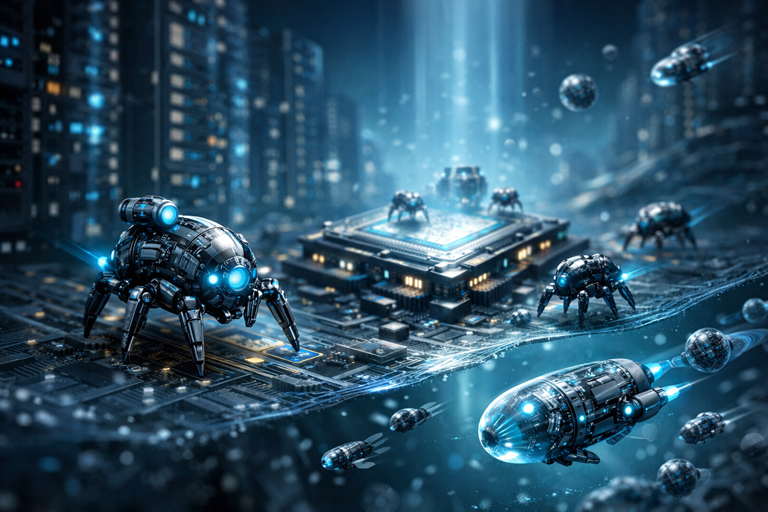
Microscopic Robots and the Future of Data Center Architecture
An in-depth analysis of the convergence of nanotechnology and cloud infrastructure.
Revolution at the Micro Scale
The recent achievement by researchers at the University of Pennsylvania and Michigan in creating autonomous microscopic robots is not just an advancement in robotics, but a demonstration of a new paradigm in computational system design. These 0.3mm robots that operate on light and function for months represent a laboratory for testing fundamental design principles under conditions of absolute constraint.
Each of these robots, costing approximately 1 cent to manufacture, can sense their environment, make decisions, and operate in coordinated groups. This level of optimization in energy consumption and space utilization offers valuable lessons for future data center architects facing similar challenges at the mega scale.
Key Features of Microscopic Robots
Unprecedented Energy Efficiency
Consumes only 75 nanowatts - 100,000 times less than a smartwatch, offering solutions for data center energy crises
Distributed Intelligence
Custom processor with redesigned architecture for specific tasks, a model for specialized computing in data centers
Long Operational Lifespan
Operates autonomously for months without maintenance or replacement, reducing operational costs
Economic Scalability
1 cent manufacturing cost enables billion-scale deployment, inspiring new economic models
Design Principles Comparison: Micro Robots vs Mega Data Centers
| Comparison Metric | Microscopic Robots | Modern Data Centers | Inspiration for the Future |
|---|---|---|---|
| Energy Consumption Pattern | Passive absorption from environment (light) | Active supply from power grid | Energy-positive data centers with renewable absorption |
| Computing Architecture | Specialized-task (ultra-light ASICs) | General-purpose (multi-purpose CPUs) | Combination of specialized and general cores in one system |
| Thermal Management | Passive dissipation in fluid | Active cooling systems | AI-based dynamic and adaptive cooling |
| Reliability | No moving parts, simple | Complex component redundancy | Self-healing designs with fault detection |
| Computing Density | Very high (at micro scale) | Medium (limited by physical space) | Unprecedented density with 3D stack architecture |
📈 Energy Efficiency Improvement Trend in Computing
💰 Computing Cost Reduction Trend Over Time
"Achieving autonomous computing at the micro scale forced us to rethink from scratch. We redesigned not only the hardware but also the computer instruction language. This is exactly the path the data center industry must take to break through the energy brick wall - fundamental rethinking, not incremental improvement."
Technology Roadmap: From Micro to Mega
Proof of Microscopic Robot Concept
Demonstration of complete computing systems at micro scale with full autonomy and nanowatt energy consumption
Integration of Design Principles in Hardware
Emergence of specialized-task processors inspired by micro robot architecture with 100x energy reduction for specific applications
Next-Generation Data Centers
Deployment of data centers based on radical optimization principles with 90% energy reduction and 10x computing density
Key Statistics and Impacts
Equivalent to 0.000000075 watts
Approximately 200-300 terawatt-hours annually
For specific targeted applications
With mass production and semiconductor techniques
Future Applications in Data Center Infrastructure
🔬 Intelligent Infrastructure Monitoring
Using millions of microscopic sensors for real-time equipment health monitoring at nano-scale with predictive failure analysis
🌡️ Adaptive Cooling Systems
Intelligent cooling systems dynamically adjusted based on heat distribution, reducing energy consumption by 40%
🔄 Automated Maintenance
Microscopic robots for detecting and repairing minor faults before they escalate into major, costly problems
"These robots are not just a technological demonstration; they are a window into a future where the boundary between biological and digital systems blurs. The future data center may look less like a warehouse of machinery and more like a living ecosystem interacting dynamically with its environment."