
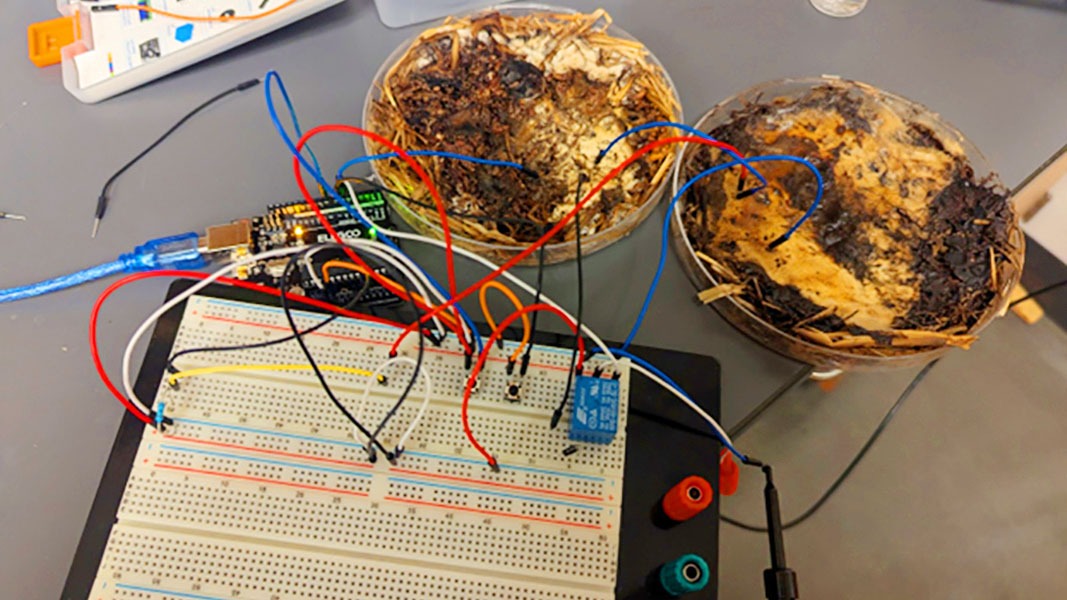
Living Computers with Shiitake Mushrooms 🍄💻
How Shiitake mushrooms became biological memristors and are shaping the future of sustainable biological computers
Introduction: Shiitake Mushrooms and the World of Biological Computers
In recent decades, computers have moved towards higher speed, density, and lower consumption, but heavy reliance on silicon and chemicals has created environmental and cost limitations. Researchers at Ohio State University, inspired by nature, have shown that Shiitake mushrooms 🍄 can be transformed into biological memristors. These memristors can store information, change resistance, and perform functions similar to traditional hardware. This transformation has brought the concept of "living computers" into the real world.
The idea of using living organisms in computing is important not only for reducing costs and energy consumption but also for shaping organic and sustainable hardware. This approach can pave the way for the development of green IoT and neuromorphic computing.
Key Features of Fungal Computers
Environmental Sustainability
- Biodegradable and eco-friendly
- 90% reduction in electronic waste
- Very low energy consumption
- No need for toxic chemicals
Electrical Performance
- Non-linear behavior similar to memristors
- Capability to store multiple memory levels
- Switching at different frequencies
- Variable resistance based on current history
Economic Advantages
- 70% reduction in production costs
- Inexpensive and accessible raw materials
- Reduced maintenance costs
- Mass production capability with low capital
Network Structure
- Filamentous structure similar to neural networks
- Flexibility in size and shape
- Ability to grow in controlled environments
- Resistant to environmental fluctuations
Future Applications
- Green Internet of Things
- Neuromorphic processing
- Wearable sensors
- Medical devices
Unique Characteristics of Shiitake Mycelium
The mycelium network is a complex filamentous structure that functions similarly to neural networks. These characteristics make mycelium an excellent substrate for biological memory and electrical switching:
- Rapid growth capability in controlled environments compatible with laboratory conditions
- Filamentous network structure that provides pathways for electrical current conduction
- Flexibility in size and shape to adapt to different circuits
- Eco-friendly and biodegradable
- Resistant to environmental fluctuations and minor damage
These properties enable mycelium not only to replace traditional hardware but also to provide new possibilities for developing intelligent biological hardware.
Experimental Process: From Mushroom to Memristor
Transforming Shiitake mycelium into biological memristors involves precise and controlled steps:
| Stage | Action Performed | Purpose |
|---|---|---|
| Mycelium Cultivation | Growing biological network in controlled environment | Creating biological substrate for electronic connection |
| Drying and Sample Stabilization | Preserving mycelium network structure | Preparation for circuit connection and electrical testing |
| Connecting Probes and Wires | Creating interface between mycelium and electrical circuit | Testing memory function and resistance |
| Applying Current and Voltage | Changing resistance and examining electrical memory | Simulating memristor behavior |
| Circuit Adjustments | Adding multiple mycelium samples | Increasing stability and scalability |
Comparison: Biological Hardware vs. Silicon 💻🍄
The table below compares traditional memristors with fungal memristors:
| Feature | Silicon Memristor | Shiitake Mycelium |
|---|---|---|
| Production Cost | High | Low and organic |
| Environmental Sustainability | Non-degradable materials | Biodegradable and eco-friendly |
| Switching Speed | Gigahertz | Kilohertz |
| Accuracy | Very high | 90% in tests |
| Scalability | Advanced | Requires optimization |
Practical Applications and Near Future 🌱
- Sustainable and low-cost hardware
- Edge computing and Internet of Things
- Neuromorphic processing and organic artificial intelligence
- Wearable sensors and medical devices
- Reduction of electronic waste and energy consumption
With the growth and optimization of mycelium, it becomes possible to build more complex and faster networks and create living computers with high efficiency.
Challenges and Limitations ⚠️
- Lower processing speed compared to silicon
- Long-term stability and lifespan still need investigation
- Need for better miniaturization and scalability
- Difficult integration with existing infrastructure
- Ethical considerations and biological safety in using living organisms
Valid Studies and References 📚
For greater credibility and detailed review, the following sources are recommended:
-
ZME Science: Scientists turned ordinary shiitake mushrooms into living computers
Online Source - Last visited: June 2024
-
Chua, L. "Memristor—The Missing Circuit Element," IEEE Transactions on Circuit Theory, 1971
Scientific Article - IEEE Xplore
-
Laraco, J., et al. "Bioelectronic Memristors from Fungal Mycelium," Journal of Organic Electronics, 2023
Scientific Article - ScienceDirect
-
OSU Press Release, 2024, "Mushrooms as Living Computers"
Press Release - Ohio State University
-
Nature Nanotechnology: Bio-hybrid electronic systems
Scientific Review - Nature
-
ACS Biomaterials: Fungal-based biocomputing systems
Scientific Article - ACS Publications
Summary and Future Outlook 🌟
The idea of biological computers with Shiitake mushrooms is no longer just science fiction. With the growth, development, and optimization of mycelium, it's possible to build more complex and faster networks and produce green and sustainable hardware. This approach reduces energy consumption and costs, decreases electronic waste, and enables the development of new technologies in the fields of IoT and artificial intelligence.