
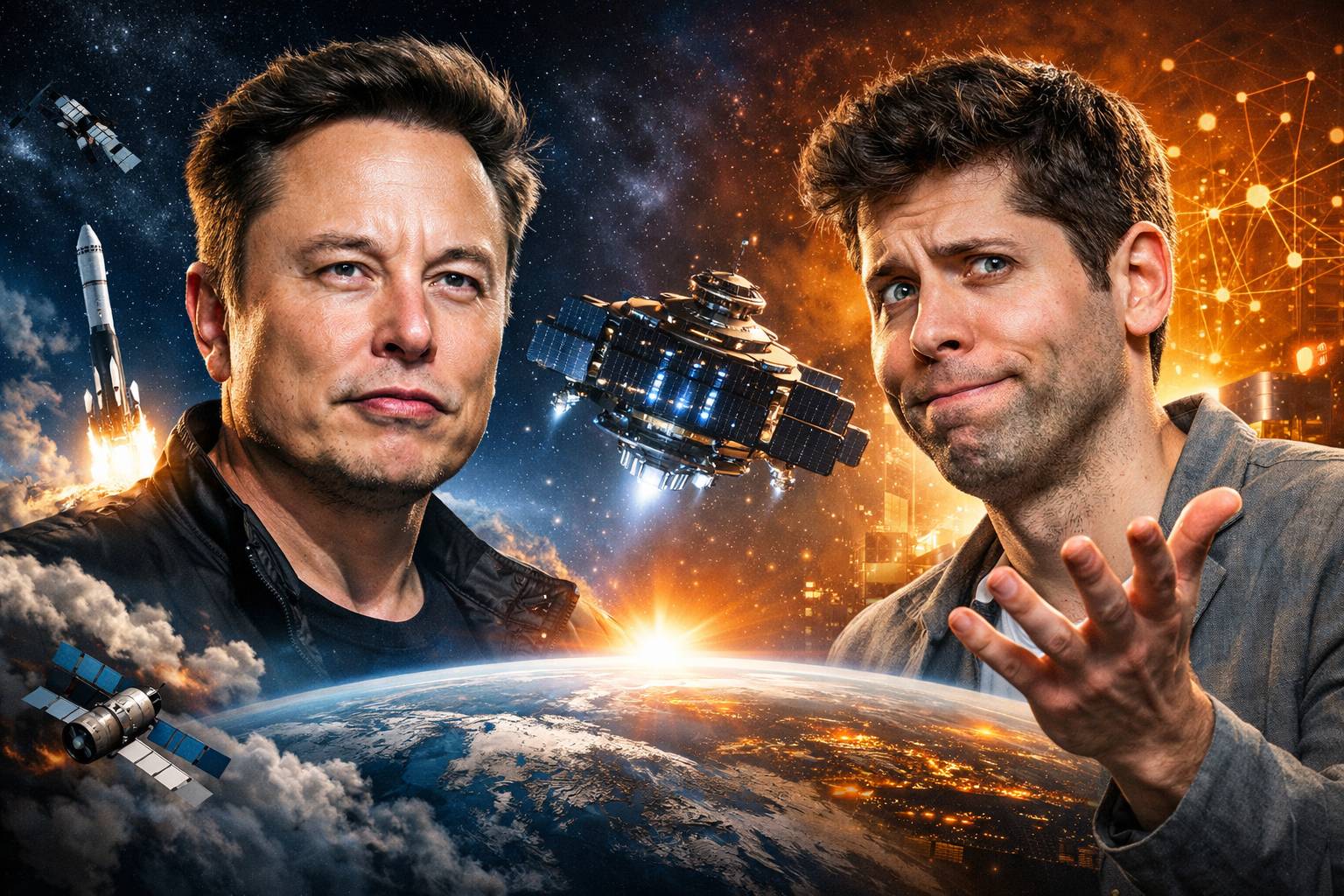
🚀 Musk: Data Centers in Space; Altman: 'Ridiculous' 🌍
As the race to build the world's most powerful AI reaches its peak, Elon Musk (SpaceX, xAI) has proposed a bold plan: moving data centers to space. But Sam Altman (OpenAI), in a live session in New Delhi, bluntly called this idea 'ridiculous.' Is this just another personal dispute between two famous Silicon Valley figures, or a deep divide in the future of AI infrastructure?
Altman emphasized that obstacles such as launch costs, chip repair in vacuum, cosmic radiation, and space debris remain unresolved. On the other hand, Musk, in recent xAI meetings, has repeatedly emphasized the priority of a "one million satellite constellation as an orbital data center" and, after xAI's acquisition by SpaceX, promised acceleration in this direction.
⚡ Two Opposing Views: Musk vs. Altman
| Dimension | Elon Musk's View (Orbit) | Sam Altman's View (Earth) |
|---|---|---|
| Core Philosophy | Escape Earth's limitations (energy, water, land, local opposition) | Optimize and scale current infrastructure |
| Prominent Supporters | Elon Musk (SpaceX/xAI), Sundar Pichai (Google Project Suncatcher) | Sam Altman (OpenAI), traditional data center operators |
| Primary Motivation | Uninterrupted global access, perpetual solar energy, physical security | Meet massive current demand with proven technologies |
| Timeline | Experimental 2027 (Google), millions of satellites in 2030s | Now until 2030: massive earth-based construction (4x increase from 2010) |
| Main Obstacles | Launch costs, heat dissipation in vacuum, irreparability, radiation, space debris | Grid pressure, water consumption, social resistance, carbon footprint |
| Special Application | 24/7 solar panels, security against terrestrial conflicts | Established supply chain, easy maintenance, fiber optics |
🌌 Why Space? The Ultimate Data Center Appeal
Space vacuum offers three unique benefits: unlimited solar energy, natural cooling, and global coverage. In orbit, a data center can draw power from the sun 24 hours a day (no night). It can easily radiate generated heat into space. It's also safe from terrestrial conflicts and local restrictions. Google's Project Suncatcher, unveiled in November 2025, moves forward with exactly this logic and promises to launch a prototype by 2027.
🔧 Why Does Altman Call It 'Ridiculous'?
Altman emphasizes the "current vision." Today, sending each kilogram of equipment to low Earth orbit costs thousands of dollars. If a hard drive fails in Oklahoma, a technician replaces it in minutes. But at 1200 km orbit, a burned component becomes the most expensive garbage in history. Additionally, high-energy solar particles can flip bits, causing computational errors in AI models. Moreover, transmitting massive data between satellites and Earth faces bandwidth limitations.
📊 Earth's Crisis: Stunning Data Center Statistics in America
According to Business Insider research, by the end of 2024, over 1,200 data centers had received construction permits across America, nearly 4 times the number in 2010. This rapid growth has sparked strong resistance from local communities in Texas, Oklahoma, and other states. Concerns about grid pressure, million-gallon water consumption, and noise pollution have accelerated the search for alternative locations like space.
| Location | Approved Facilities by 2024 | Growth vs 2010 | Local Resistance Level |
|---|---|---|---|
| California | 210 | 3.2x | High |
| Texas | 320 | 4.5x | Very High |
| Virginia | 280 | 3.8x | Moderate |
| Ohio | 150 | 5x | High |
| Other States | 240 | 2.7x | Variable |
Elon Musk: Extraterrestrial Boldness
A "one million satellite constellation" serving as a data center. With xAI's integration into SpaceX, the path to realizing this dream has been smoothed. He seeks a radical solution to bypass Earth's limitations, leveraging Starlink synergy and fully reusable rockets.
Sam Altman: Smart Pragmatism
'Ridiculous' doesn't mean impossible forever, but rather the misplaced focus today. Altman believes that until 2030, efforts should focus on earth-based data center efficiency, clean energy, and reducing tension with local communities. He acknowledges space for the more distant future, not now.
⏳ Timeline: From Test to Reality
| Period | Possible Events | Altman's View |
|---|---|---|
| 2026-2027 | Google prototype launch (Project Suncatcher); SpaceX/xAI hiring and design | "Proof of concept, not scale" |
| 2028-2030 | Testing laser communications and processing on modified Starlink satellites | "Still doesn't make sense this decade" |
| 2030-2035 | Special applications: secure financial computing, government, military support | Maybe limited applications |
| 2035-2040 | If launch costs drop 90% and space robotics mature, Musk's dream could be tested at scale | Earth-based still more efficient? |
Conclusion: Sam Altman is right in assessing today's ideas. The technical and economic barriers are so high that launching massive data centers in the short term seems 'ridiculous.' But Elon Musk is playing the long game. He builds rockets, launches satellite internet, and pursues AI simultaneously. Perhaps in the 2040s, what seems ridiculous today might become a path to Earth's survival. A battle between today's pragmatism and tomorrow's boldness.