
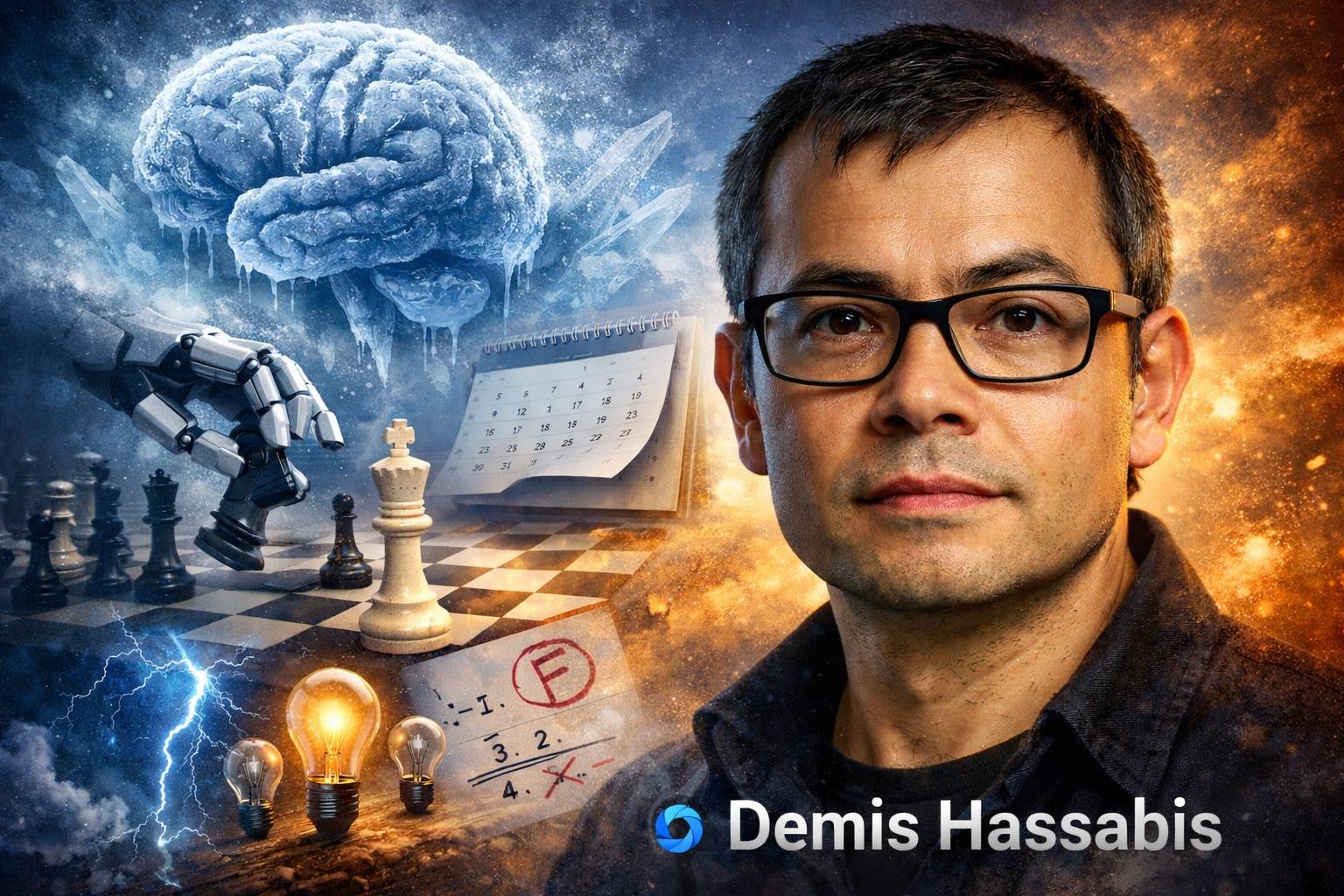
Artificial General Intelligence (AGI) and Three Unsolved Mysteries According to DeepMind's CEO
🔹 Definition of AGI and Its Current Status
Artificial General Intelligence (AGI) refers to a system capable of performing any intellectual task as well as a human. Demis Hassabis, CEO of Google DeepMind and Nobel Prize winner in Chemistry 2024, stated clearly in his latest remarks at the New Delhi Summit: "We have not yet achieved true AGI." He has identified three fundamental flaws in current systems: lack of continuous learning, weakness in long-term planning, and inconsistent performance. This contrasts with claims from some Silicon Valley executives who assert that AGI has been achieved.
⚡ Three Fundamental Limitations According to Hassabis
Frozen Learning
Models stop learning from new experiences after training. To update them, they must be retrained from scratch.
Long-term Planning
AI plans ahead for at most a few hours, while humans plan for years.
Performance Inconsistency
A system can solve complex problems yet strangely fail at simple basic tasks.
📋 Comparative Table: Human Intelligence vs. Current AGI
| Capability | Today's AGI | Human |
|---|---|---|
| Lifelong Learning | ❌ Stops after training | ✅ Daily learning and adaptation |
| Strategic Planning | ⚠️ Short-term (hours to days) | ✅ Long-term (years) |
| Performance Stability | ❌ Unstable (fails at basic tasks) | ✅ Consistent and reliable |
| Personalization | 🧊 Requires retraining | ✅ Immediate adaptation to user |
| Causal Understanding | 📊 Statistical correlation | 🌐 Causal world model |
* These gaps show that AGI is still in its early stages.
📊 Capability Comparison Chart (AGI vs Human)
🔄 Applications Where AGI Falls Short (Scroll)
🩺 Personal Physician
Knows rare diseases but doesn't learn from your new medical records.🔬 Research Scientist
Good at initial experiment design but impossible to manage 5-year projects.📈 Business Analyst
Creates marketing plans but may violate accounting principles.🤖 Home Robot
Excellent in fixed environments but gets lost when furniture is rearranged.🧑🏫 Private Tutor
Knows the subject matter but cannot adapt teaching style to student's learning preferences.⏳ Next Steps to True AGI (10-Year Vision)
🔮 Demis Hassabis: "We are five to ten years away from true AGI, provided we overcome these three limitations."
🔎 Conclusion: The Deep Gap with Human Intelligence
AI advances in the last decade have been remarkable: from massive language models to solving protein folding. But according to DeepMind's founder, we have not yet built a "mind." Three fundamental limitations – frozen learning, short planning horizons, and inconsistent performance – show that machines still lack flexibility, stability, and deep understanding of the world. Despite claims from some that AGI has been achieved, a longer path lies ahead; a path requiring conceptual innovations, not just scaling up models. Hassabis's remarks at the New Delhi Summit provide a clear roadmap for researchers: until machines can learn like a child, plan like a strategist, and perform consistently like an expert, artificial general intelligence will remain a distant dream.
This discussion continues at the highest levels with Sam Altman (OpenAI), Dario Amodei (Anthropic), and Sundar Pichai (Google). We must wait to see which of these obstacles the next generation of systems will overcome.